


While personality rights in India have been the preserve of film stars and athletes, the Delhi High Court’s May 7, 2026 order marks one of the first known instances where a major Indian startup entrepreneur has secured such broad legal protection. The suit alleged unauthorized merchandise using his catchphrases “Hum Bhi Bana Lenge” and “DOWN, BUT NOT OUT!”, social media impersonation, and commercial misuse of his persona. Each, attempted to monetize the goodwill Aman Gupta built through Boat Lifestyle and Shark Tank India.
The case establishes something important: personality rights are no longer just a Bollywood problem. If you’ve built a public identity as a founder, creator, or public figure someone will monetize it without your permission. If Aman Gupta’s case shows what happens when identity is commercially exploited, imagine a political leader accused of passing an insensitive statement he never actually made. An example has already knocked the doors of the courts.
AI and machine learning tools were allegedly used to create hyper-realistic deep fake videos portraying Shashi Tharoor making politically sensitive statements he never made with the disinformation campaign timed deliberately to coincide with his campaigning for the Kerala Legislative Assembly elections 2026, in an attempt to tarnish his patriotic credentials and unlawfully interfere with the democratic electoral process.
The court’s response was equally unprecedented. The Delhi High Court went beyond standard image protection restraining unauthorized use of Tharoor’s name, visual likeness, distinct voice, and in a particularly striking departure, his signature oratorical cadence and highly refined vocabulary. X and Instagram were directed to immediately take down the infringing content.
Personality rights protecting a speaking style and vocabulary is genuinely new legal territory. Together, these two cases map the full spectrum of the problem — from a founder’s catchphrase being sold on a T-shirt, to a politician’s fabricated voice being used to rig public opinion. Where Aman Gupta’s case is fundamentally about commercial exploitation of a personal brand, the Tharoor case is about public deception and democratic harm. Same legal gap. Wildly different consequences.
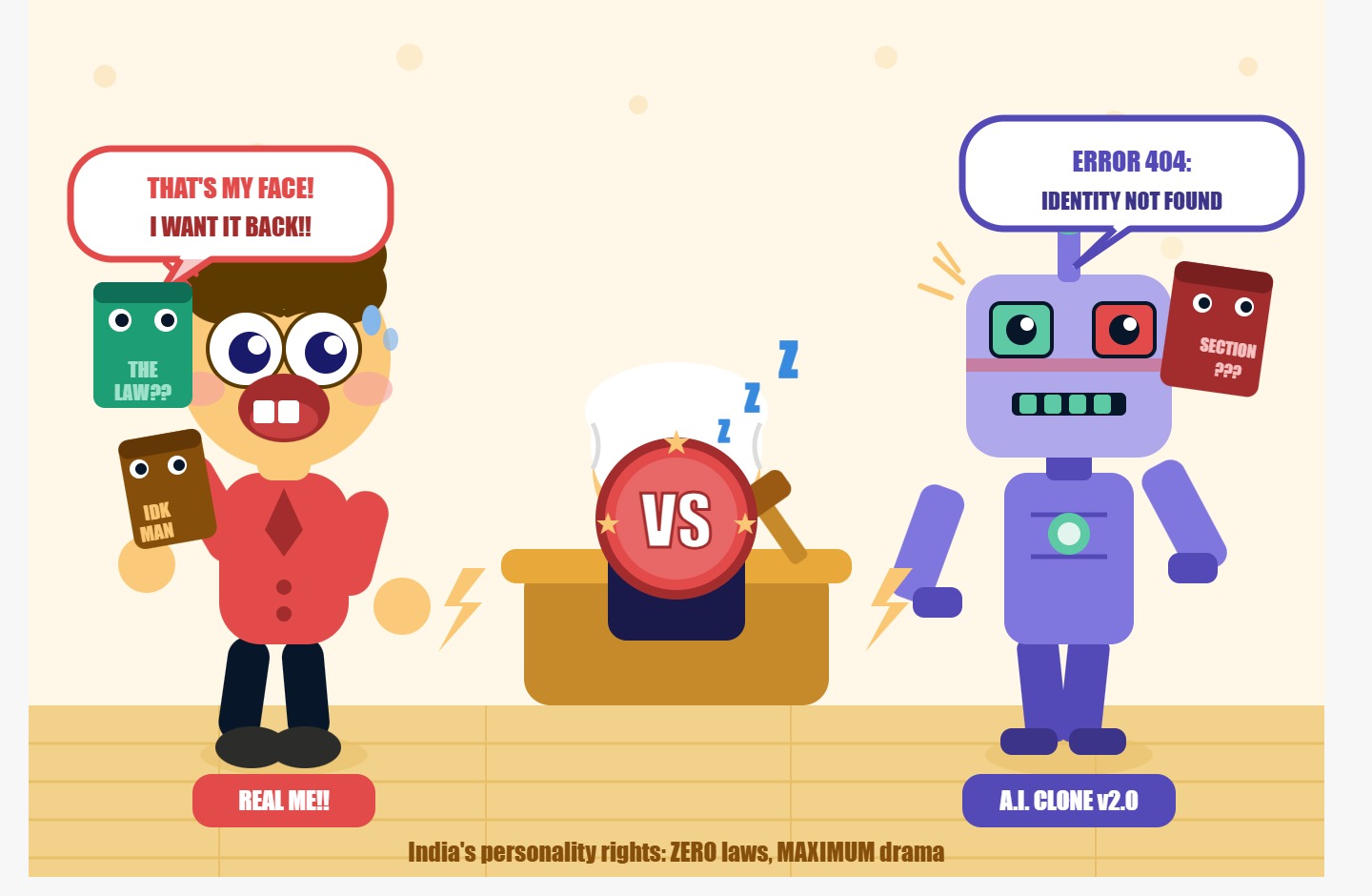
India does not have a personality rights law. What we have are courts improvising with the Copyright Act, Trade Marks Act, passing off doctrine, and Article 21 stitching together and providing protection that the legislature never actually provided.
One recent court order describes a celebrity’s name, voice, gestures, and manner of dialogue delivery as constituting his “copyrights” but under Section 13 of the Copyright Act, copyright subsists only in specified categories of original works. A person’s name, likeness, or public persona does not ordinarily constitute a “work” capable of copyright protection. Courts are stretching doctrine to deliver justice admirable in intent, but it creates dangerous unpredictability for everyone. The line between legitimate protection and over-enforcement is not yet clearly drawn. Political satire, parody, and mimicry have always drawn on the voices and mannerisms of public figures. A legal framework that extends protection to speaking style or vocabulary without carefully defined limits could collide directly with free speech guarantees under Article 19(1)(a) of the Constitution.
Meanwhile, Tennessee enacted the ELVIS Act and the US is debating the NO FAKES Act — purpose-built legislation for the AI era. India continues to patch existing IP doctrine to cover gaps it was never designed to fill. Courts are doing the heavy lifting, case by case, but judicial improvisation is not a substitute for legislative clarity. Parliament has yet to define any framework specifically governing personality rights or AI-driven impersonation. Until it does, the protection available to any given individual will depend entirely on which judge they appear before and which doctrine that court chooses to stretch.